
Chapter 5 /7 · The Little Blue Book
Stair Stringer Layout
How to lay out a stair stringer from total rise and run. Five rules, one comfort ratio, every riser within an eighth of an inch of every other riser.
After reading
Lay out a stair stringer of any height with risers within 1/8 inch of each other, treads at the right run, and a stringer that ties cleanly into the joist header.
The stair as a giant rafter
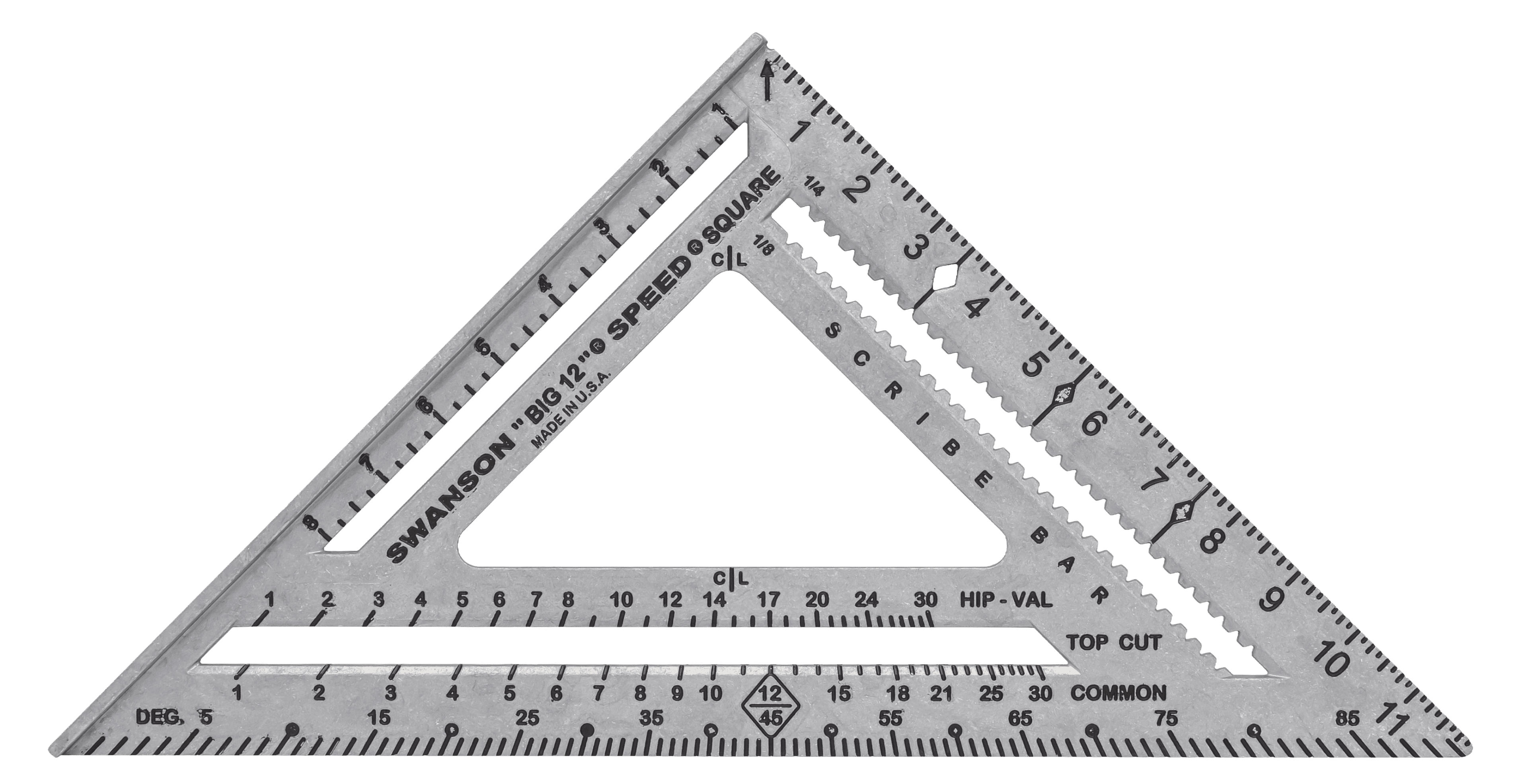
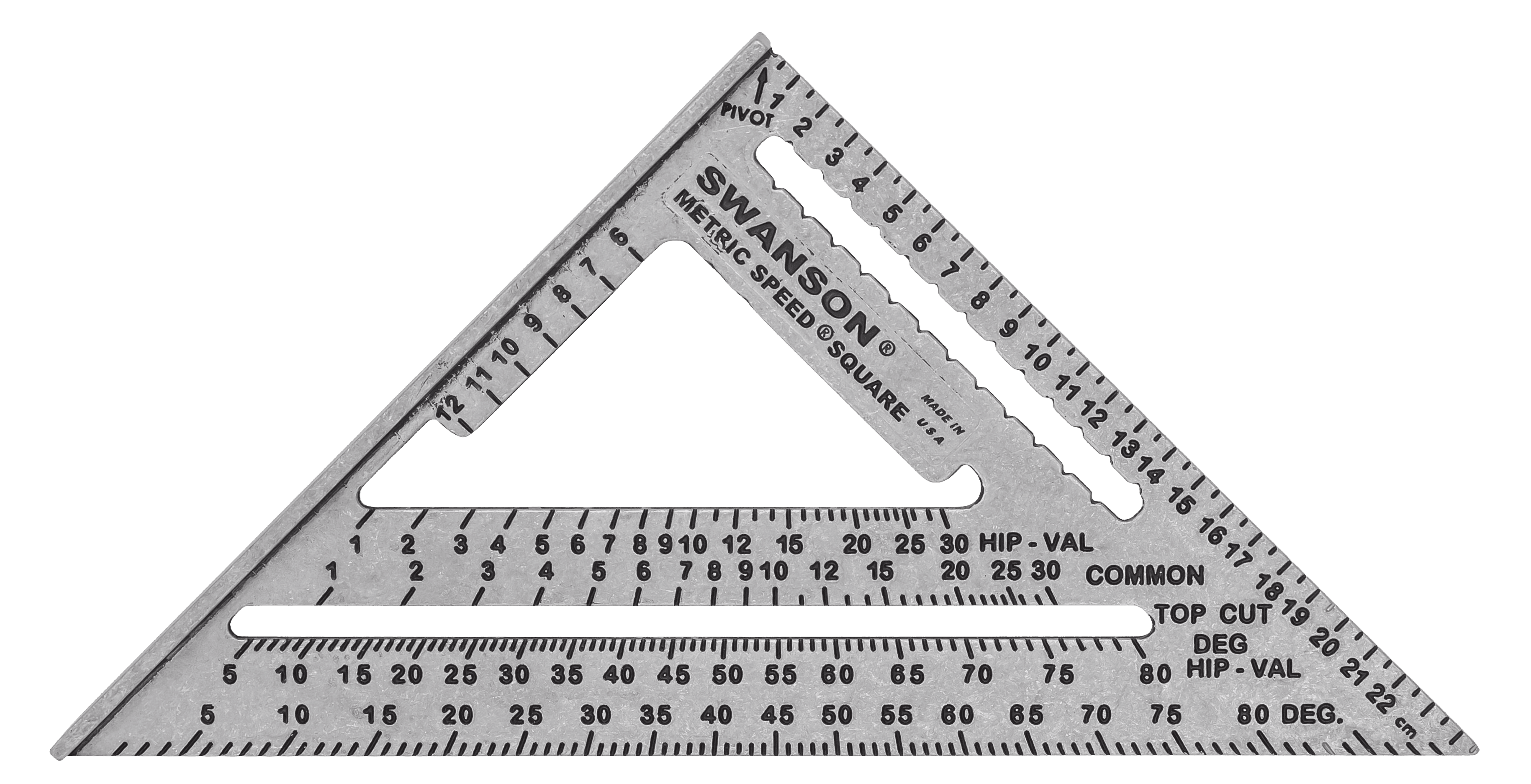
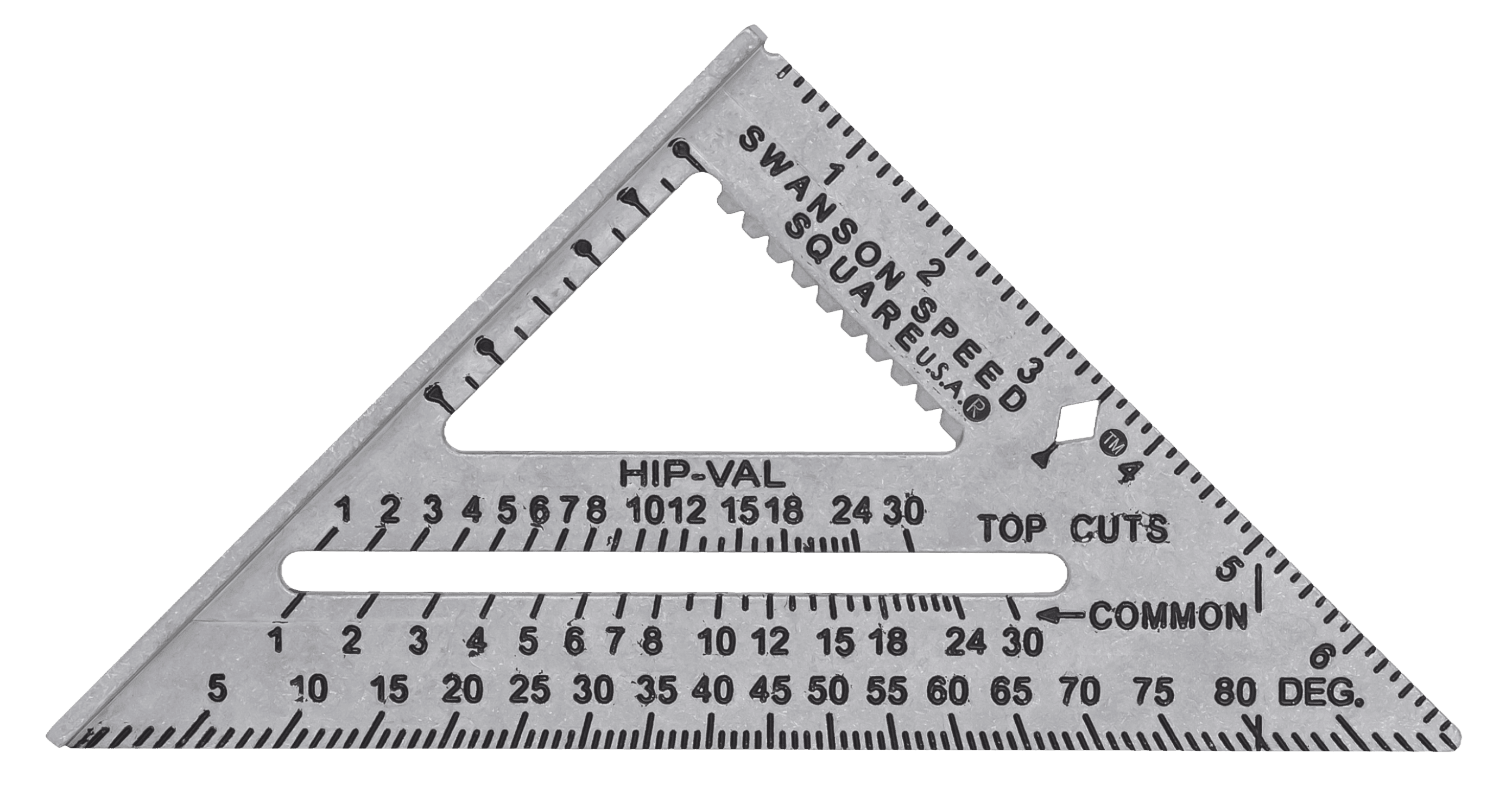
A stair stringer is a rafter rotated. The total rise is the height from the top of the lower floor to the top of the upper floor. The total run is the horizontal distance the stair covers. The stringer is the diagonal piece of lumber that holds the treads and risers, laid out exactly the way a rafter is laid out, with the Speed® Square pivoted on each step.
The five rules of a comfortable stair
A century of building stairs taught framers a handful of quick rules. None of them require a calculator; all of them keep a stair from feeling steep, shallow, or unbalanced.
Stair stringer, side elevation
Figure 04Comfort check
Riser
7 1/4″
Tread
10 1/4″
Riser + Tread
17.50″
In the comfort range
Riser height
7 1/4″
You can build a second stringer by nailing the triangular cutouts from the first stringer on the edge of a 2x4 or 2x6, thus saving material. Make sure it matches the rise and run of the other stringer. A good fitting riser adds support to a tread rather than leaving the stairs "open" without a riser.
The diagram shows stringer supported by metal joist hangers. At cement walls you may even want to support stringers with legs down to the floor. There is usually more than one way it can be done, but stay with the basic rules and information for proper layout.
When installing the risers and treads, set riser down behind and nail into back edge of tread.
BASIC STAIRWAY LAYOUT
- Draw your complete stairway on paper! It's a lot easier to erase pencil lines than to tear out wood!
- The sum of all unit runs (tread less nosing) = TOTAL RUN.
- The sum of all unit risers = TOTAL RISE (measured from FINISHED floor to FINISHED floor).
- As the angle of a stairway changes, so does the riser-tread ratio. (see chart A)
- Three general rules for Riser-Tread Ratio (excluding Tread nosing, which extends 1" to 1-1/2" beyond riser):
- Rise plus tread width = 17" to 18"
- Rise times tread width = 72" to 76"
- Sum of two risers plus tread width = 24" to 25"
- An "ideal" ratio is 7-1/2" rise and 10" tread. These dimensions may vary slightly if the rise and / or run of a stairway must be held within certain limits. This is explained later.
- Avoid going more than 8-1/4" rise or less than 9" wide tread. Try to keep around the 34º to 37º angle.
- A main stairway should be at least 36" wide, or even 42" if possible, with 6'8" headroom. This width and height is needed for moving furniture as well as people.
- Handrails should be 30" to 34" above nosing of steps, and 34" high on landings.
- If you must turn a stairway 90º, using a landing is more desirable and safer than three winding steps (called winders). A landing is treated as a regular step with a larger tread. The landing can be supported by legs going down to the floor below, and it should be at least as wide and long as the width of the stairs. If you are making a 'U" turn in the stairs, the landing will have to be at least two times the width of the stairs in order to accommodate the second set of stringers that lead on down. These stringers are tied into the framework of the landing in the same manner as though you were coming from the regular floor. Maintain the same rise and tread width all the way down. (Fig. 3)
- Using three winders (Fig. 5 & 6), each tread tapers from a wide to narrow, but not pointed, tread at inside of turn. At a point 15" to 18" from the narrow end, where you normally walk, tread width on the three winders should be the same as the rest of the stairs. To
Determine proper size and shape of the three winders, first layout three full size winders on templates of paper or cardboard and fit them into your turn.
FIGURING THE RISERS:
First:ote Page 5
Assume we have a stair with a total rise of 7'11" (95"). We want about a 7" rise per step (staying close to a 35º angle). To determine the number of risers we take 95 ÷ 7 = 13.571 risers. We can't use a half riser, so we will increase each of the 13 risers just a little to make up this approximately 3-1/2" (1/2 riser). Now 95" ÷ 13 = 7.308". About the closest you will get to 7.308 is 7-5/16" which is 7.312.hart. Now we will recheck by taking 7.312 x 13 = 95.056" total rise. This is almost 1/16" too much. Rather than trying to divide.056 up between the 13 risers. (unless you want to. Then it is.004 off each riser), just take it off of the bottom riser. We are now back to our 95" total rise.
In building the stairs, if each riser is within 1/8 inch of any of the other riser heights there should not be any noticable difference as you "walk the stairs." This allows you to "adjust" the stringer to the correct total rise. You can also do this with the tread width for total run, but that is not usually any problem.
FIGURING THE TREADS:
With 13 risers at 7-5/16" each, we will have 12 treads (always one less tread). Using our three general rules we have:
Total rise, total run, and the stringer
Once you know the riser height and the tread run, the stringer length follows from the same Pythagorean math as a rafter. The Blue Book steps you through the worked example below.
- 7-5/16" (rise) + 10-3/16" (calculated run) = 17½" (17-18 ideal).
- 7.312 (riser height) x 10.187 (run) = 74-1/2 (72"-76" ideal).
- 7.312 + 7.312 (sum of 2 risers) + 10.187 (run) = 24.81 (24" - 25" ideal). 12 treads x 10.187" (run) = 122-1/4" (10' 2-1/4") for total run.
What if you don't have 122-1/4"? You could get away with a 9-11/16" run (smallest amount which when added to the rise would give us 17") for a total run of 116-1/4"; or use a steeper stair with only 12 risers and just 11 treads. 95" rise ÷ 12 risers = 7.917. We'll use 7-59/64" (7.922 per unit rise). This is almost 8". Don't go any steeper. 7.922 x 12 = 95.064, again within 1/16". Checking our #1 rule, we could use a 9-1/16" (9.062) run. 9.062 x 11 treads = 99-5/8" total run. If that is still too long a run, you will need a landing to turn the stairs either to the right, left or "U" turn. In that case, re-adjust the run and rise to work closer to the 35° angle.
To figure the length of stringer use the following example as a guide:
Find the stringer length for a stair with a rise of 95" and a run of 122".
- 1Rise of 95": 95 x 95 = 9025
- 2Run of 122": 122 x 122 = 14884
- 39025 + 14884 = 23909
- 4Square root of 23909 = 154-5/8" or approx. 13'.
- 5Add on 12 to 18 inches for waste.
Sizing the stairwell opening
The opening above the stair has to clear headroom from every tread. Chart A below sizes the opening based on rise height and tread run.
DETERMINING LENGTH OF STAIRWELL OPENING
Formula
Formula for stairwell well opening length.
Treadwidth (less nosing) divided by Riser Height, multiplied by H, equals Well Opening. H equals required head room plus total distance through upper finished floor construction (see Fig. 1).
H equals required head room plus total distance through upper finished floor construction.
CHART A
Rows
13
Approx. Angle to Floor Line
- Rise (Inches)
- 6½
- Tread Run
Approx. Angle to Floor Line
- Rise (Inches)
- 6¾
- Tread Run
- 10¾
Approx. Angle to Floor Line
- Rise (Inches)
- Tread Run
- 10½
Approx. Angle to Floor Line
- Rise (Inches)
- 7¼
- Tread Run
- 10¼
Approx. Angle to Floor Line
- Rise (Inches)
- 7½
- Tread Run
Approx. Angle to Floor Line
- Rise (Inches)
- 7¾
- Tread Run
- 9¾
Approx. Angle to Floor Line
- Rise (Inches)
- Tread Run
- 9½
Approx. Angle to Floor Line
- Rise (Inches)
- 8¼
- Tread Run
- 9¼
Approx. Angle to Floor Line
- Rise (Inches)
- 8½
- Tread Run
Approx. Angle to Floor Line
- Rise (Inches)
- 8¾
- Tread Run
- 8¾
Approx. Angle to Floor Line
- Rise (Inches)
- Tread Run
- 8½
Approx. Angle to Floor Line
- Rise (Inches)
- 9¼
- Tread Run
- 8¼
Approx. Angle to Floor Line
- Rise (Inches)
- 9½
- Tread Run
FOR OUTSIDE STEPS. Riser-tread ratios are slightly different. Concrete steps are much safer with a 6" to 6-1/2" rise with a 12" to 13" tread width. On wood, a 6" to 7" maximum rise using 2" x 12" stock for treads (which gives about 11-1/2" tread width) can be used. The treads of exterior stairs should slope forward about 1/8" for drainage, so the cuts in the stringers are slightly more than 90°. This can be done by simply cocking pointed end of layout bar 1/8" out beyond edge of "Big 12®"® square where it crosses outside edge of stringer. Keep other end of layout bar flush with square. In effect, you are laying out a "crooked corner" 1/8" out of square.