
Chapter 4 /7 · The Little Blue Book
Cutting a Hip or Valley Rafter
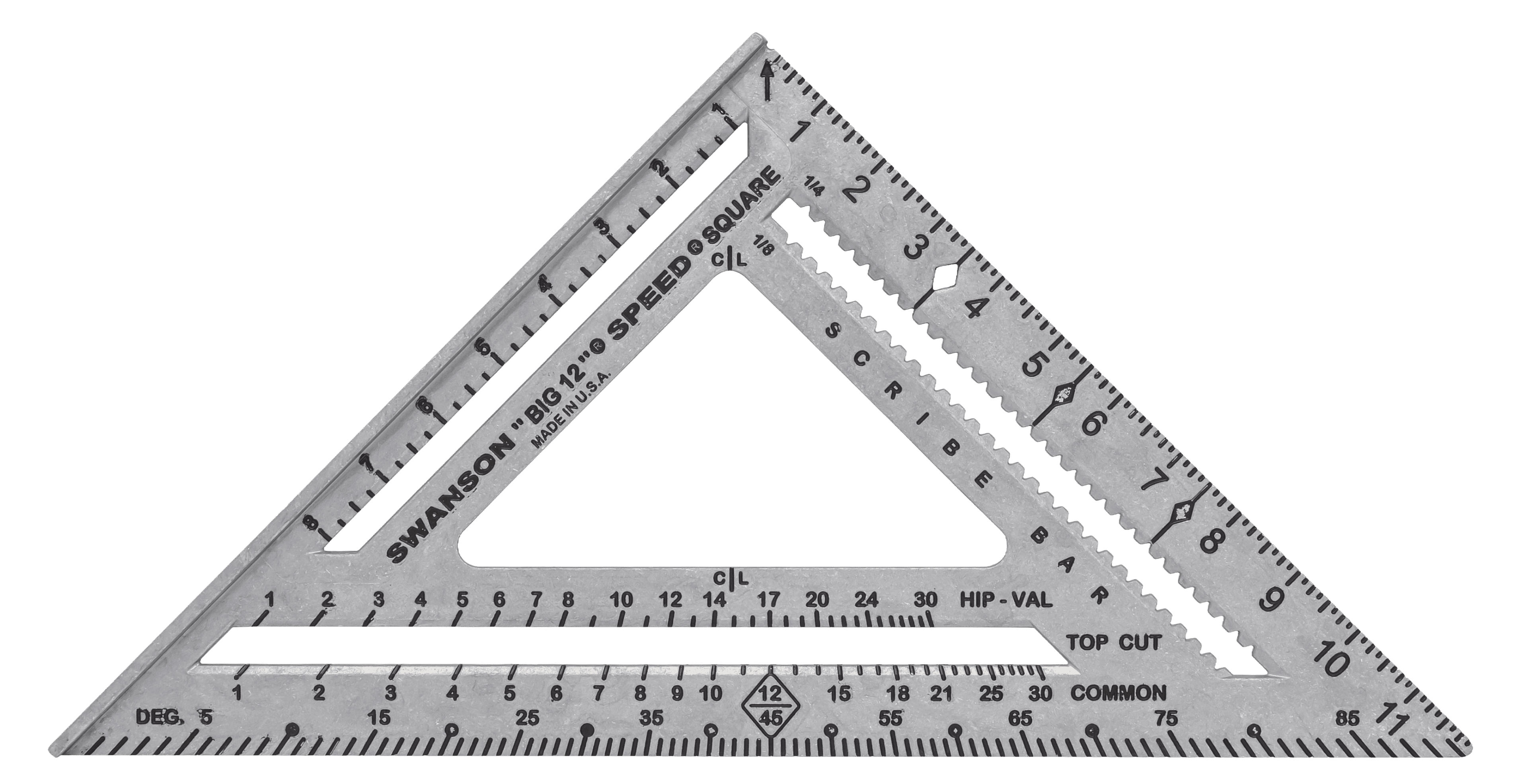
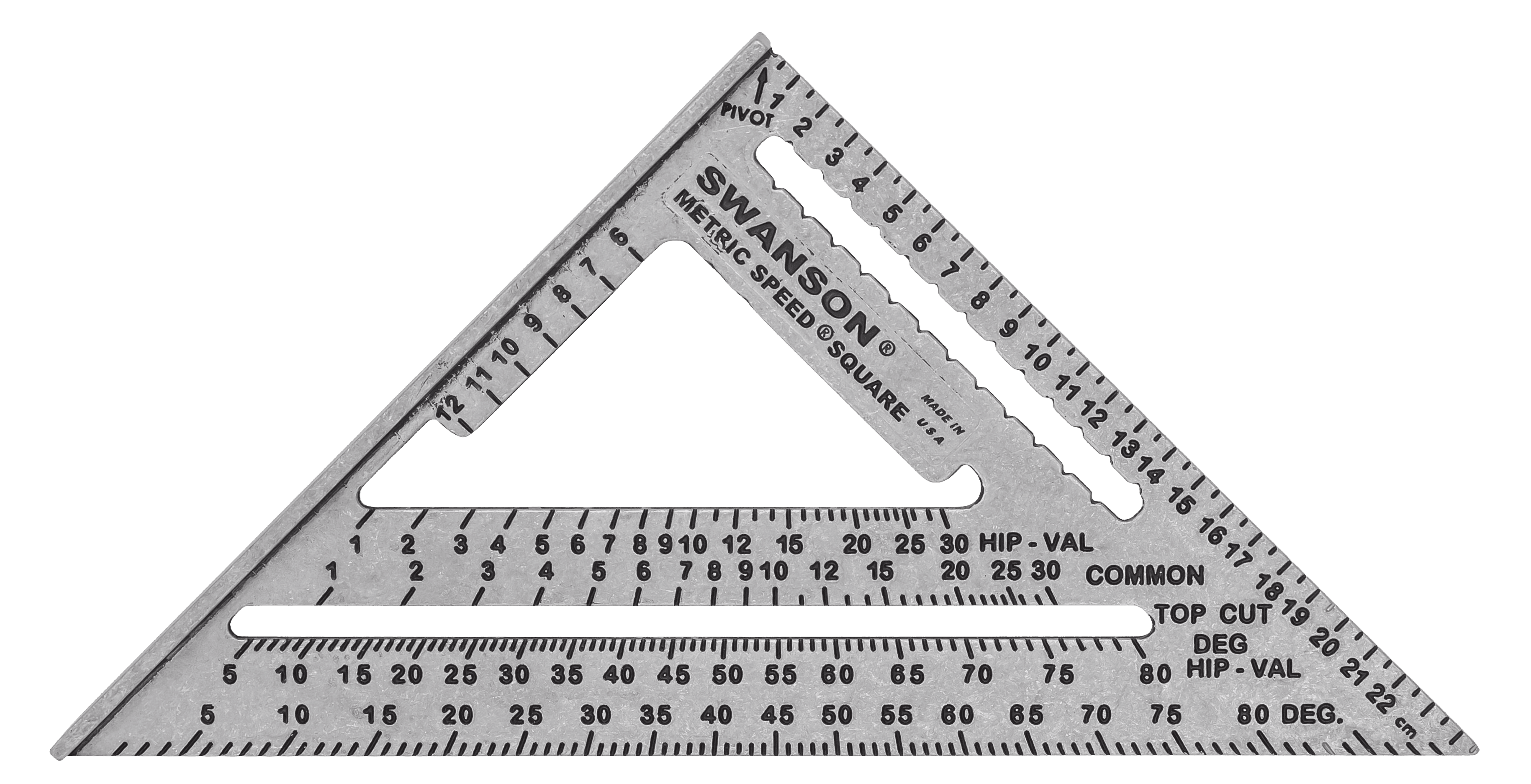
The cuts that frame the corners of the roof. Same Speed® Square, different scale: one rise number gives both the common AND the hip / valley length, with a 45 degree cheek cut at the corner.
After reading
Lay out a hip or valley rafter from the same rise + run as a common rafter, with the right plumb cut at the ridge, the right cheek cut at the corner, and the bird's mouth that lets it sit on the corner of the wall plate.
Where it lives in the roof
A hip rafter runs diagonally from the corner of the building up to the ridge. A valley rafter runs from the inside corner of two intersecting roof planes down to the eave. Both run at 45 degrees to the common rafters, which means the layout math is identical to a common rafter; the table just gives you a longer answer for the same rise number.
The bird's mouth and the seat cut
The bird's mouth is the notch at the bottom of the rafter that lets it sit flat on the wall plate. The seat cut is the horizontal portion; the heel cut is the vertical drop. Same notch on a hip or a common; the only difference is the angle of the cheek cuts at the top.
Bird's mouth, on the wall plate
Figure 03The three cuts
Pitch
5 / 12
How the table reads for a hip
The master rafter length table reports two values per rise: common rafter length per foot of run, and HIP / VAL rafter length per foot of run. Same rise number, second column. The hip / valley always runs longer because of the 45 degree reach.
When using the "Big 12®"® square, run the plumb line through the 1"-12" scale at the 7" mark and in line with notch at opposite side. Adjust square up or down plumb line until 3-1/2" mark is at edge of material. Mark along inch scale for seat cut. ( or 9b)
Common vs hip rafter, same rise
Figure 02The math, both rafters
Hover any term · the geometry highlights
Common rafter
Hip / valley rafter
Same rise number on both. The hip's run is 17" instead of 12", so its rafter length is always longer at the same pitch.
Pitch
5 / 12
RUN-RISE RELATIONSHIP TO RAFTER LENGTH
In the example in the common rafter rises 5" for each 12" of run; and this requires 13" of rafter length. Each additional 12" of run makes the rafter 13" longerable C at 5" rise). At a 5' total run, rafter length is 5 x 13" or 65" long. Fractions of foot run are figured in proportion. 6" of run 2.5" rise & extra 6.5" rafter length. 3" of run = 1.25" rise & extra 3.25" rafter length, etc.
Remember, our tablesare for total WIDTH of building, so a 3" RUN would be equal to a 6" building WIDTH (run 1/2 width or span).
Laying the hip or valley out
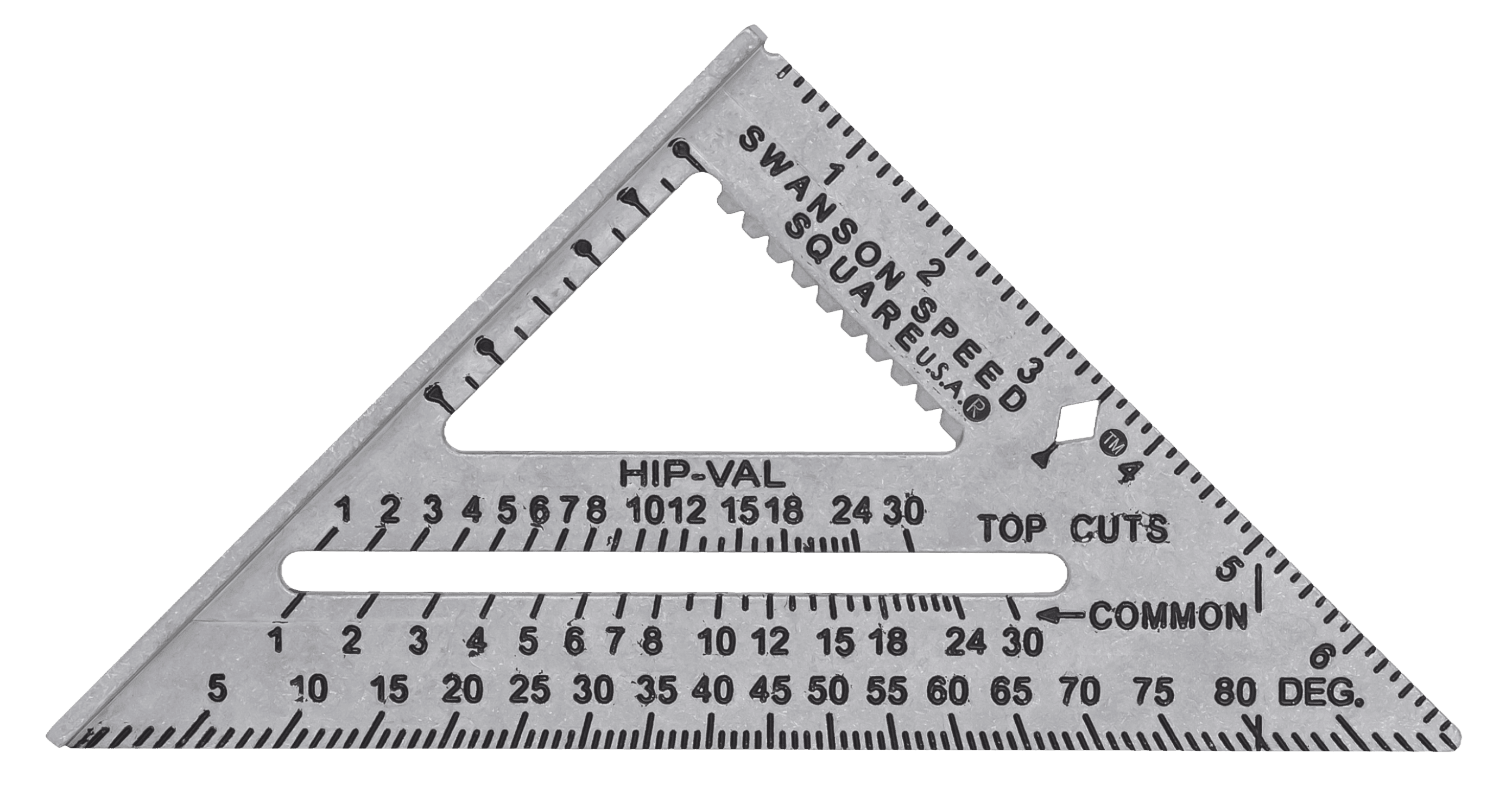
On the Speed® Square, the HIP-VAL scale uses the same rise number as the COMMON scale. Pivot at the top of the rafter, line up the rise number, mark along the long edge.
LAYING OUT HIP OR VALLEY RAFTER
Because a HIP or VALLEY RAFTER runs at a 45° angle, it has a "longer reach" to the ridge than the common rafter. Therefore it will always have a 16.97"(rounded off to 17") run for every unit of rise, in comparison to the 12" run of the common rafter in (16.97 is the length of the diagonal - which is what the HIP/VALLEY is - of a 12" x 12" square). Using the example from, each additional 17" (not 12") of run would make the HIP/VALLEY 17.69" longerable C at 5" rise). A Valley rafter, because it has to carry more weight, should be one or two sizes larger.
The basic length of the rafter can be taken from the Tables, but I would suggest you measure each one separately. If the building isn't square they will vary. With the crown up, mark the plumb cut at top end using HIP-VAL scale. Measure down top of Hip for proper length and draw another plumb mark. This plumb mark will be part of the birds mouth layout and will fall in line with corner of plate. Add on any additional amount for overhang by using HIP-VAL building width tables 1"-11"Remember a 5" overhang increases the building width by 10" so measurement at "10" would be length to add. A 15" overhang would increase building by 30" so 3 x measurement at "10" would be length to add.
The hip's extra cuts: cheek + dropping
A hip rafter needs a double cheek cut at the top (where it meets the ridge between two common rafters) and rafter dropping or backing along the top edge so the roof plane breaks cleanly. Both follow from the table; both start with the same single rise number.
Cheek cut at the ridge, top view
Figure 05The math, live
Hover any term · the geometry highlights
How much to subtract from the hip rafter's centerline length
Ridge thickness
1.5″
The diagram shows Tail of Hip fit into corner of Fascia Board. If you should "mess up" the double cheek cut (explained in & 15) and tail ends up being too short, nail a scab onto the sides of Hip (dotted line on).
Because the plane of the roof breaks down from the center line of the Hip, this leaves the edges of the Hip about 1/4" too high on 1-1/2" wide lumber. The Hip can be dropped by cutting seat cut 1/4" deeper, thus lowering the Hip (Line G,). Valley rafter is not dropped.
For ease of explanation, the hip and valley measurements and layouts are based on the usual framing practice where the ridge and rafter material are the same thickness, 1-1/2" in the following example.
Before cutting, move back from top plumb line "A" approximately 1/4" to line "B". Set saw to 45° angle and cut on "B". Determining distance from plumb lines "A" to "B" is explained under SHORTENING OF THE HIP (p.23).
The same century-old numbers
The HIP / VAL column has been on the master table since 1925. Scrub across the editions below to see the same values in three typographic eras.
A century of the same table.
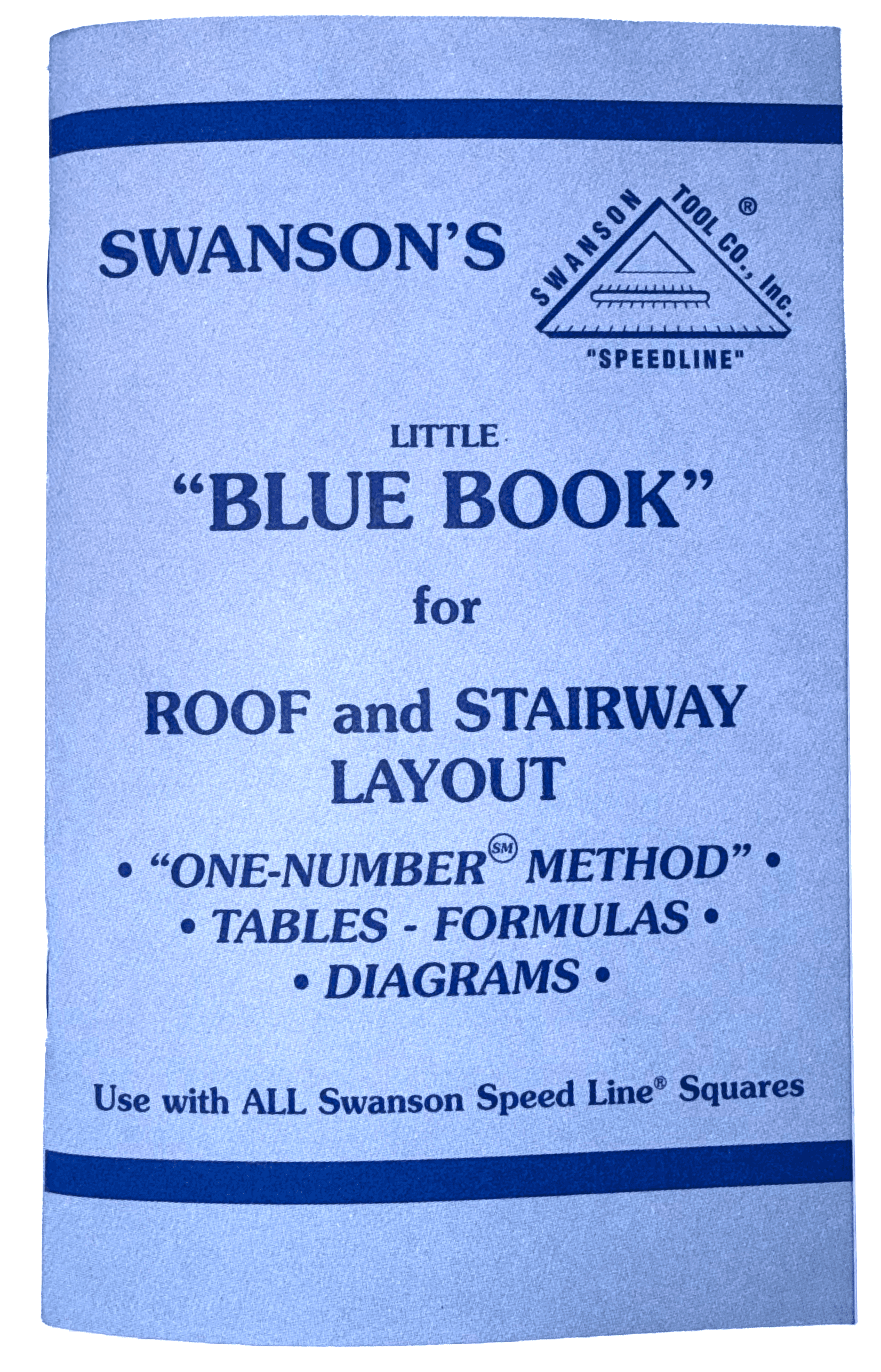
The rafter length math hasn't changed since Albert Swanson printed it in 1925. The typography modernized, the columns reflowed, the cover got new ink. But the numbers a framer cuts to today are the numbers from the first edition.
| Rise | Pitch | Common rafter (per ft of run) | Hip / Valley (per ft of run) |
|---|---|---|---|
| 1.00″ | 12.04″ | 17.00″ | |
| 6.00″ | 1/4 | 13.42″ | 18.00″ |
| 8.00″ | 1/3 | 14.42″ | 18.76″ |
| 12.00″ | 1/2 | 16.97″ | 20.78″ |
| 16.00″ | 2/3 | 20.00″ | 23.32″ |
| 24.00″ | Full | 26.83″ | 29.39″ |
Same numbers Albert Swanson printed in 1925.
Open the full 1925 TableRead it in the original voice
The original edition treated common, valley, and hip rafters as one continuous chapter on rafter cutting. Below is that original chapter, sanitized of print-only references and presented as a single read.
COMMON RAFTER
COMMON RAFTER: One running at right angles (90°) from plate to ridge. The common rafter will form the diagonal leg (hypotenuse) of a 90° triangle, with the rise and run forming the 90° angle of the triangle.
The diagram also shows correct points from which to measure. Study them and remember the picture when you are on the job. Where the arrows show | Rafter Length |, these are the lines to measure from. When your lumber is not straight, always put the crown or high side up when laying out any rafter. When laying out rafter (lets assume 5" rise), start at top end of rafter. Lay square on face of rafter, with "T" bar of square down over the edge of rafter. Pivot square to where number 5 on common scale lines up with same edge of rafter as pivot point. Keep pivot point tight against edge of rafter. Start your mark at pivot point, marking along top edge of square. This gives the top plumb cut, to fit against ridge.
Measure the rafter length along top edge of rafter. Mark another plumb cut same as above. This line represents outside wall of the building. (The same point from which you measured the width of the building). Add whatever length you want for a tail or eave to the rafter lengths given in the. Mark at end of tail on rafter is plumb cut, same as one at top end of rafter. The tails of the rafters may be cut on
The ground, or wait until rafters are all in place and mark the ends to a line and cut,whatever is the easiest. To get the Bottom or Heel cut.
VALLEY RAFTER: One running diagonally from the plate to the ridge at the intersection of gable extension with main roof.
HIP RAFTER: One running diagonally from the plate to the ridge.
Since both hip and valley rafters run at a 45º angle to the common rafter, they both represent the diagonal or hypotenuse of a right triangle; the three sides being the hip, plate and common rafter, or the valley, ridge and common rafter. Therefore, the cuts and lengths apply equally to hip and valley rafters.
You will notice the square has a separate Hip-Val Scale which must be used for either of these two rafters. But always use the same number on Hip-Val scale as you used on the common rafter scale,the number representing inch rise. The reason for the separate Hip-Val scale is that the hip and valley rafters run at 45º to the common rafter, and therefore must be longer. In, the hip rafter has a horizontal run of 17" to rise 12", while the common rafter rises 12" in only 12" of horizontal run. This requires a different angle for the plumb cuts. In, square is held on rafter and pivoted in the same manner as with a common rafter, but using the Hip-Val scale. If building is out of square, one
Hip will be cut a little shorter, depending on how great the error is. Keep longer corner at top end of hip up even with top of ridge. Keep ridge and hips well propped up until roof boards are nailed. Watch that you don't put a bow in ridge or hip while nailing other rafters to them.
To find intersection points of center of hips on ridge, leave ridge about a foot too long at point where both hips intersect the ridge. Take a regular length common rafter (such as used on main roof). Set bottom cut over edge of plate and in line with ridge. Make sure your walls are straight. Place top end of common rafter along side of the ridge, bringing top point of common even with top of ridge. Mark across top of ridge at this point. This mark is the center line of the two intersecting hips. The common rafter used to get this intersection point would be placed in the same position as the one in that comes in line with the ridge and runs underneath the little dormer on the 20'0" wall side. This way you know the rise of the hips will be the same as the rise of the common rafter on main roof. Leave the bottom ends of the hips (eave end) a little short so they will not interfere with lining up the facia boards at the corner.
JACK RAFTERS: One which does not extend from plate to ridge. Hip Jack, one running from plate to hip at 90º to plate. Valley Jack, one running from ridge to valley at 90º to ridge. Cripple Jack, one which neither touches the ridge nor plate, but runs from a hip rafter to a valley rafter at 90º to the ridge.