

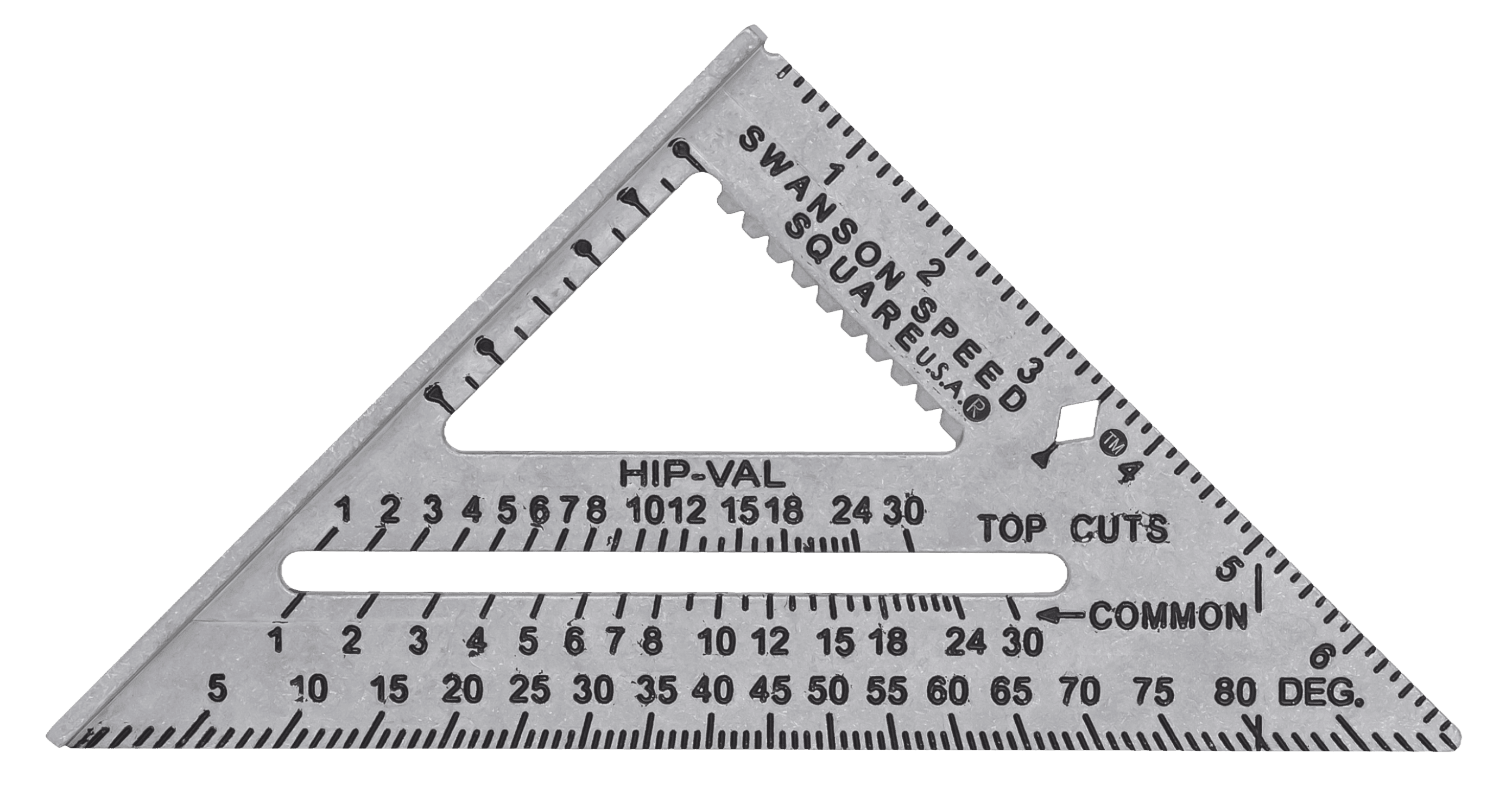
Roof Pitch Reference
The conversion every framer carries in their head: rise per foot of run, the pitch fraction, the angle in degrees, and the rafter length per foot. The table that turned trigonometry into a glance.
After reading
Convert between rise / run, pitch fraction (1/4, 1/3, 1/2, full), angle in degrees, and rafter length per foot of run for any pitch from 1/12 to 24/12.
The four ways to talk about a roof
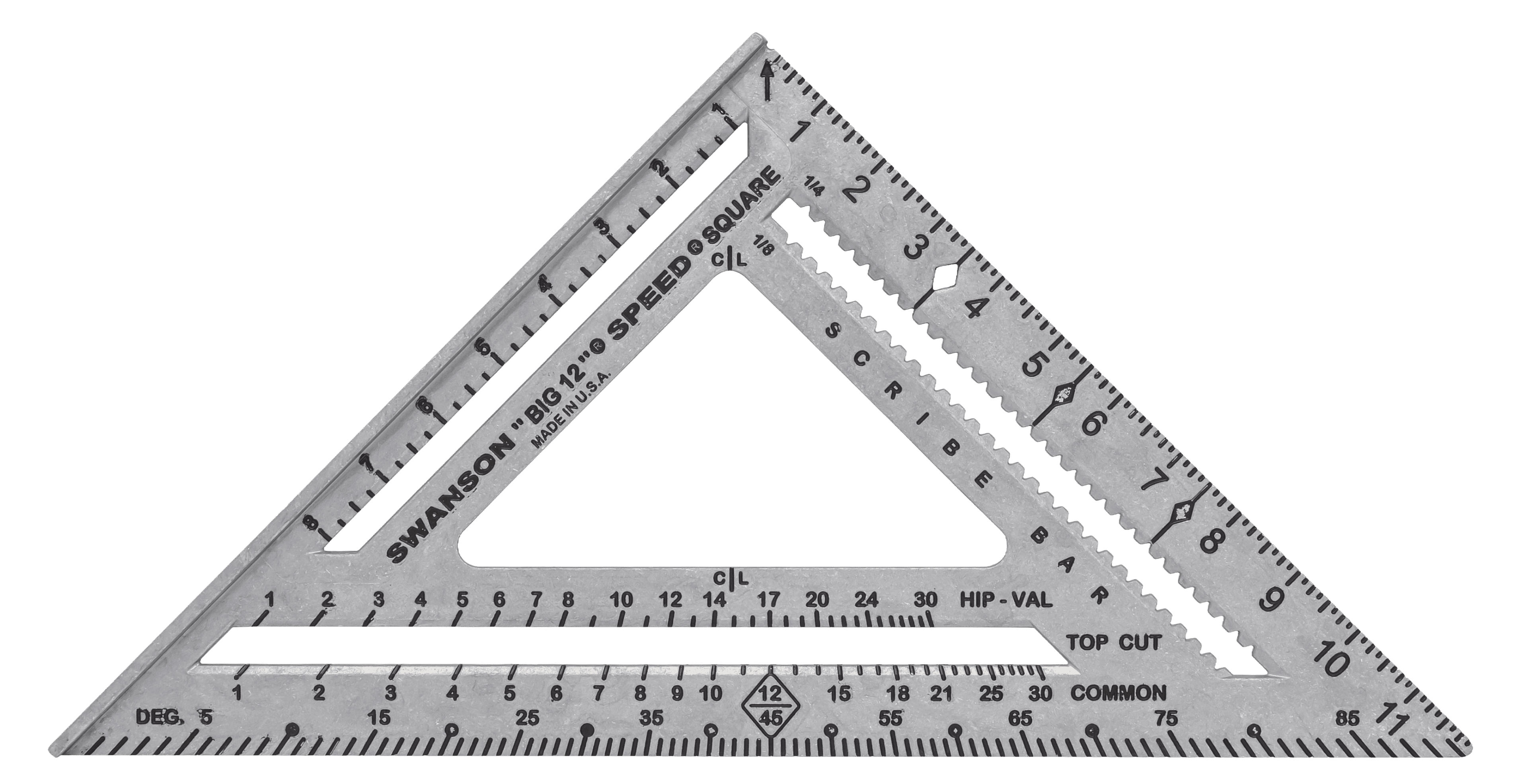
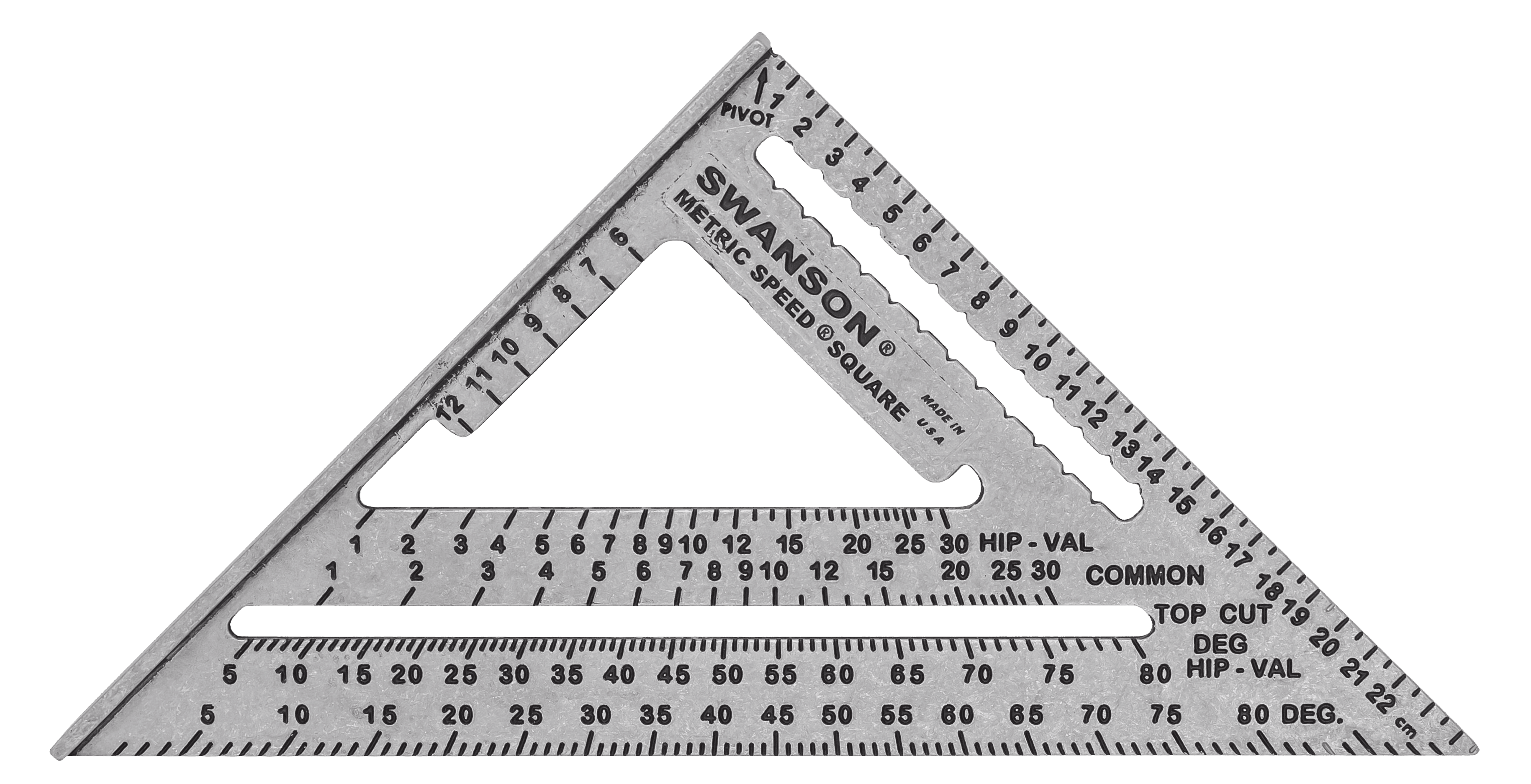
A framer can describe the same roof four ways: by rise (5 inch rise per foot of run), by pitch fraction (5/12), by angle (about 22.5 degrees), and by name (a "half pitch" is 6/12, a "full pitch" is 12/12). The Speed® Square uses the inch-rise; the printed table converts everything else.
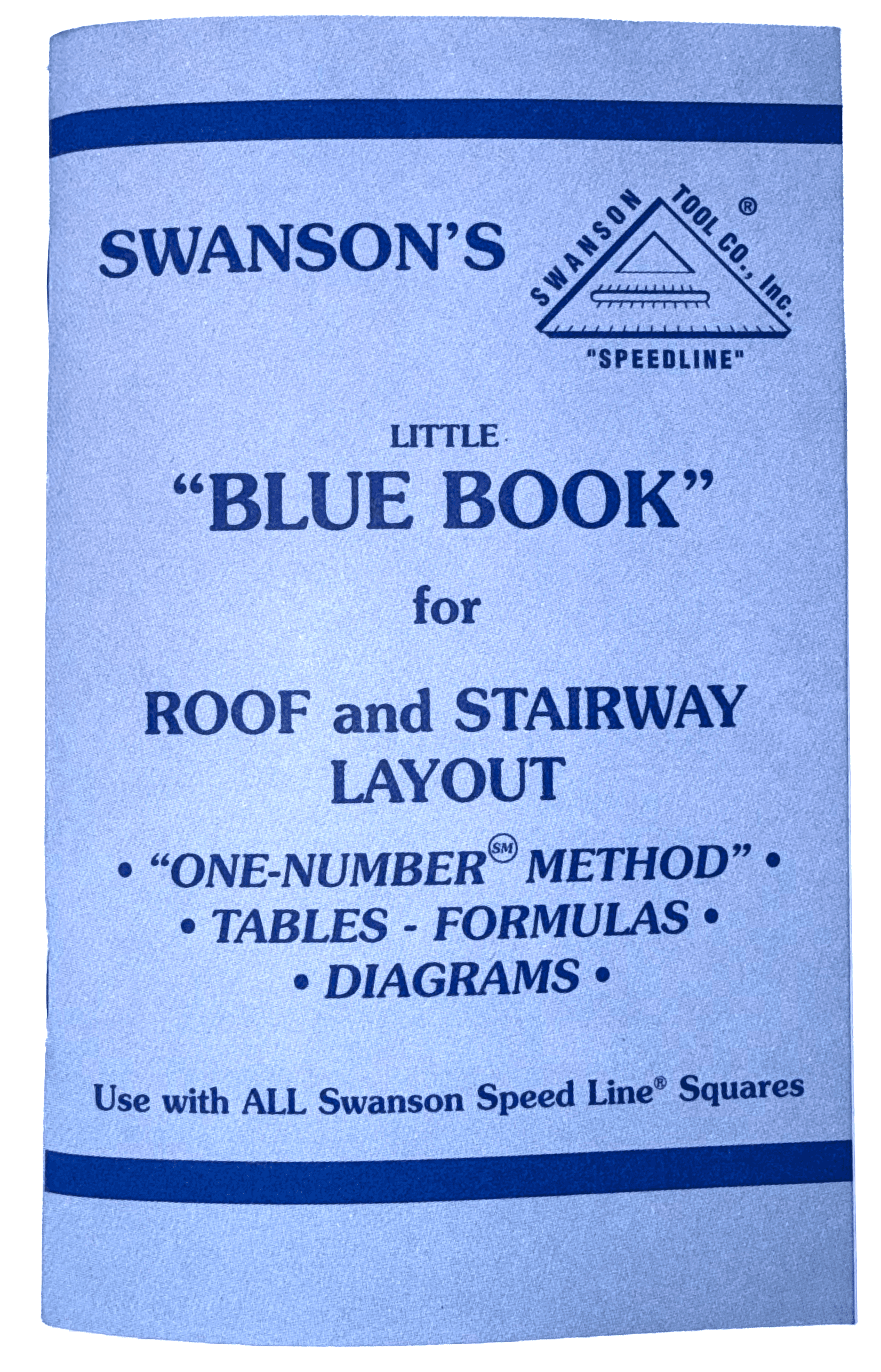
How the print Blue Book defines pitch
Pitch as a fraction equals rise divided by span (not run). A "full" pitch roof rises a distance equal to half the building width. Below is the canonical pitch-name table from the Pro edition.
A "Full" pitch roof is one having a 24" rise for 12" run. Here is a Table of various pitches. Pitch equals rise divided by span; being the proportion the rise bears to the span.
Table of Various Pitches
Rows
11
Inch Run
- Inch Rise
- Pitch
- 11/12
Inch Run
- Inch Rise
- Pitch
- 5/6
Inch Run
- Inch Rise
- Pitch
- 3/4
Inch Run
- Inch Rise
- Pitch
- 2/3
Inch Run
- Inch Rise
- Pitch
- 7/12
Inch Run
- Inch Rise
- Pitch
- 1/2
Inch Run
- Inch Rise
- Pitch
- 5/12
Inch Run
- Inch Rise
- Pitch
- 1/3
Inch Run
- Inch Rise
- Pitch
- 1/4
Inch Run
- Inch Rise
- Pitch
- 1/6
Inch Run
- Inch Rise
- Pitch
- 1/12
USING THE RAFTER LENGTH TABLES
In the following pages are tables giving the lengths of any common, hip or valley rafter for any pitch up to a 24" rise, and for building widths up to 40 feet.
The diagram gives one example of the use of these tables. The main building is 20' wide x 30' long with a 7" rise. Thus, the hip rafters are 15' 3⁵⁄₈" long, and the common rafters 11' 7". The 15' x 15' addition, hips and valleys are 11' 5⁵⁄₈" long and the commons 8' 8³⁄₈". For the 10' Gable Dormer on top of the roof boards, the longest rafters are 5' 9 ¹⁄₂".
A "width in inches" table iswhich gives the amount to add for inches in case the width does not measure out in even feet. Simply add the length given for the inches in relation to the rise, to the length given for the even foot tables. Lengths given do not include eave projection.
It is best to use a steel tape in measuring the width of building, measuring from outside to outside of plate upon which rafters will rest, or if boarding extends to top of plate measure to outside of boards. If a ridge board is used, deduct the thickness of same from building width.
For building widths greater than is given in this book, take any two widths which when added together equal the width wanted. Find the lengths for these two widths and add them together; for instance for 49' width take width of 20 and 29 and add together.
THE DEGREE SCALE
The same pivoting method used to determine rafter cuts is used with the degree scale. By remembering that the square forms a 45° right triangle, it can be used to measure any angle with the use of the degree scale.
How to use the rafter length table
For any pitch from 1 to 30 inch rise, the master table gives the rafter length per foot of run for both common rafters and hip / valley rafters. Multiply by your run in feet to get the cut length.
RAFTER LENGTHS FOR 1"-30" ROOF RISE
To find total overall length of a common rafter refer to Table C. Example: For a 22" rise roof the length per foot run is 25.06". If building were 29'8" wide (forget the 8" for now) the run would be 14.5' (1/2 of 29'). 14.5 x 25.06" = 363.37" divided by 12" = 30.280 ft. (.280 of a foot multiplied by 12" = 3.36" or 3⅜") or 30'3⅜". Turn to "inches in building width" table (p. 48). Go down rise column to 22 and across to 8" (not 4.) Add the 8⅜" to 30'3⅜" = 30' 11¾". Deduct 1/2 of the thickness of ridge and add on overhang. If a 12" wide eave is desired a minimum of 25.06" is needed, plus tail cut loss "A". If brick, consider distance brick work extends out from edge of top plate. Figure hip-val rafters the same. Tail cut loss "A" is based on 8" lumber. Pitch is a term which technically refers to total rise compared to total width; so a 1/2 pitch means roof rises a distance equal to 1/2 of total building width, or a 1/6 pitch means roof rises 1/6th of building width, etc. Although a mathematician may apply "pitch" as described above, the tradesman thinks of "pitch" in terms of inch rise per foot of run.
Formula
To convert between pitch and rise per foot
To convert use: 24 x pitch = rise per foot, or rise per foot divided by 24 = pitch, or see Table C
24 \times \text{pitch} = \text{rise per foot} \quad \text{or} \quad \frac{\text{rise per foot}}{24} = \text{pitch}Type your pitch and span. The rafter answers.
6/1226.6°
24ft
Common rafter length
13′ 5″ 1/16″
161.04″ per rafter · 13.42″ per ft of run × 12 ft of run
- Pitch
- 6/12
- Angle
- 26.6°
- Per ft of run
- 13.42″
Schematic geometry. Not to scale, true math, every pitch.
The same numbers since 1925
The master rafter length table is the most-referenced page in the Blue Book. The numbers are identical in all three editions.
A century of the same table.
The rafter length math hasn't changed since Albert Swanson printed it in 1925. The typography modernized, the columns reflowed, the cover got new ink. But the numbers a framer cuts to today are the numbers from the first edition.
| Rise | Pitch | Common rafter (per ft of run) | Hip / Valley (per ft of run) |
|---|---|---|---|
| 1.00″ | 12.04″ | 17.00″ | |
| 6.00″ | 1/4 | 13.42″ | 18.00″ |
| 8.00″ | 1/3 | 14.42″ | 18.76″ |
| 12.00″ | 1/2 | 16.97″ | 20.78″ |
| 16.00″ | 2/3 | 20.00″ | 23.32″ |
| 24.00″ | Full | 26.83″ | 29.39″ |
Same numbers Albert Swanson printed in 1925.
Open the full 1925 TableThe 1925 master table, unedited
The original 1925 rafter length table, sanitized of print-only references and presented as Albert Swanson printed it.
Length of Rafter per Foot Run (In Inches)
Length of Rafter per Foot Run (In Inches)
Rows
30
Angle in Deg.
- Rise
- Pitch
- ,
- Tail Cut loss "A"
- ,
- Common Rafters
- Hip-Val Rafters
Angle in Deg.
- Rise
- Pitch
- 1/12
- Tail Cut loss "A"
- ,
- Common Rafters
- Hip-Val Rafters
Angle in Deg.
- Rise
- Pitch
- ,
- Tail Cut loss "A"
- ,
- Common Rafters
- Hip-Val Rafters
Angle in Deg.
- Rise
- Pitch
- 1/6
- Tail Cut loss "A"
- 2¾"
- Common Rafters
- Hip-Val Rafters
Angle in Deg.
- Rise
- Pitch
- ,
- Tail Cut loss "A"
- ,
- Common Rafters
- Hip-Val Rafters
Angle in Deg.
- Rise
- Pitch
- 1/4
- Tail Cut loss "A"
- Common Rafters
- Hip-Val Rafters
Angle in Deg.
- Rise
- Pitch
- ,
- Tail Cut loss "A"
- ,
- Common Rafters
- Hip-Val Rafters
Angle in Deg.
- Rise
- Pitch
- 1/3
- Tail Cut loss "A"
- ,
- Common Rafters
- Hip-Val Rafters
Angle in Deg.
- Rise
- Pitch
- ,
- Tail Cut loss "A"
- Common Rafters
- Hip-Val Rafters
Angle in Deg.
- Rise
- Pitch
- 5/12
- Tail Cut loss "A"
- ,
- Common Rafters
- Hip-Val Rafters
Angle in Deg.
- Rise
- Pitch
- ,
- Tail Cut loss "A"
- ,
- Common Rafters
- Hip-Val Rafters
Angle in Deg.
- Rise
- Pitch
- 1/2
- Tail Cut loss "A"
- Common Rafters
- Hip-Val Rafters
Angle in Deg.
- Rise
- Pitch
- ,
- Tail Cut loss "A"
- ,
- Common Rafters
- Hip-Val Rafters
Angle in Deg.
- Rise
- Pitch
- 7/12
- Tail Cut loss "A"
- ,
- Common Rafters
- Hip-Val Rafters
Angle in Deg.
- Rise
- Pitch
- ,
- Tail Cut loss "A"
- Common Rafters
- Hip-Val Rafters
Angle in Deg.
- Rise
- Pitch
- 2/3
- Tail Cut loss "A"
- ,
- Common Rafters
- Hip-Val Rafters
Angle in Deg.
- Rise
- Pitch
- ,
- Tail Cut loss "A"
- ,
- Common Rafters
- Hip-Val Rafters
Angle in Deg.
- Rise
- Pitch
- 3/4
- Tail Cut loss "A"
- Common Rafters
- Hip-Val Rafters
Angle in Deg.
- Rise
- Pitch
- ,
- Tail Cut loss "A"
- ,
- Common Rafters
- Hip-Val Rafters
Angle in Deg.
- Rise
- Pitch
- 5/6
- Tail Cut loss "A"
- ,
- Common Rafters
- Hip-Val Rafters
Angle in Deg.
- Rise
- Pitch
- ,
- Tail Cut loss "A"
- Common Rafters
- Hip-Val Rafters
Angle in Deg.
- Rise
- Pitch
- 11/12
- Tail Cut loss "A"
- ,
- Common Rafters
- Hip-Val Rafters
Angle in Deg.
- Rise
- Pitch
- ,
- Tail Cut loss "A"
- ,
- Common Rafters
- Hip-Val Rafters
Angle in Deg.
- Rise
- Pitch
- Full
- Tail Cut loss "A"
- Common Rafters
- Hip-Val Rafters
Angle in Deg.
- Rise
- Pitch
- ,
- Tail Cut loss "A"
- ,
- Common Rafters
- Hip-Val Rafters
Angle in Deg.
- Rise
- Pitch
- ,
- Tail Cut loss "A"
- ,
- Common Rafters
- Hip-Val Rafters
Angle in Deg.
- Rise
- Pitch
- ,
- Tail Cut loss "A"
- Common Rafters
- Hip-Val Rafters
Angle in Deg.
- Rise
- Pitch
- ,
- Tail Cut loss "A"
- ,
- Common Rafters
- Hip-Val Rafters
Angle in Deg.
- Rise
- Pitch
- ,
- Tail Cut loss "A"
- ,
- Common Rafters
- Hip-Val Rafters
Angle in Deg.
- Rise
- Pitch
- ,
- Tail Cut loss "A"
- Common Rafters
- Hip-Val Rafters
Common questions
What is roof pitch?
Roof pitch is the rise of a roof per 12 in. of horizontal run. A 6/12 pitch rises 6 in. for every 12 in. of run. Pitch is the reference number every rafter cut, hip-val cut, and stair layout comes off of on a Speed® Square.
How do you measure roof pitch?
Roof pitch is measured with a level and a ruler. Set a level across the roof (or against a rafter), hold it dead level, and measure the vertical distance from the level to the roof surface at exactly 12 in. from the pivot. That vertical distance in inches is the pitch (rise per 12 in. of run). A Speed® Square + torpedo level is enough gear to read pitch on any roof.
What is a 6/12 pitch in degrees?
6/12 pitch is 26.57 degrees. The formula is arctan(rise / run), so arctan(6 / 12) = 26.57°. The Blue Book pitch reference table lists degrees, slope percent, and pitch labels side by side; carpenters read the pitch number directly, not the degree, because the Speed® Square scale is calibrated to the pitch.
What are the most common roof pitches?
The most common residential roof pitches are 4/12, 5/12, 6/12, 7/12, 8/12, and 9/12. Below 4/12 the roof is considered low-slope and needs a different shingle spec; above 12/12 the roof is steep-slope and typically framed with pre-cut rafter tables or trusses. The Blue Book pitch reference covers 2/12 through 24/12.
Cutting a Common Rafter
Lay out a common rafter from rise + run + length, with the right plumb cut at the ridge and the right tail cut at the eave.
RaftersCutting a Hip or Valley Rafter
Lay out a hip or valley rafter from the same rise + run as a common rafter, with the right plumb cut at the ridge, the right cheek cut at the corner, and the bird's mouth that lets it sit on the corner of the wall plate.
ReferenceBuilding Width Adjustments
Look up the rafter length for any building width from 12 to 40 feet, including the add-ons for the inch fractions in between.